30 Junie 2026
Wanneer iemand vertrek voor hulle gaan
In that little room, we learn that dementia does not only steal memory. It rearranges people. It pulls faces from old photographs and places them over the living.
Thoughts About Ageing Parents
When Someone Leaves Before They Are Gone
A thin winter sun lies over the garden.
The grass is still wet. The wild olive tree beside my bedroom window stands almost motionless, but among the leaves, little birds are stirring. They chatter and flutter as if the morning knows nothing of goodbye.
I stand at the window with my coffee mug.
The mug is warm against my hands.
My fingers hold on to it as if warmth could keep something from happening.
Outside, the garden gleams.
Inside me, an old longing lies quiet.
I think of my father.
Of how quickly he was gone. Too quickly. Without the long approach one imagines will somehow prepare you. There was a short sickbed. After that, words like lung cancer, specialist, too late.
Words that arrive too late do not make loss any softer.
By then, we were already on the gravel road of life. Dust on the tyres. Pain in the body. Things not yet fully processed.
And then another goodbye.
I still miss him, even though much water has run to the sea since then. Time does not make love smaller. A father remains your father — all the way into eternity.
Two weeks ago, we said goodbye to my mother-in-law.
Not with grand final sentences. Not with a deep conversation in which everything was beautifully rounded off. Her words had already been few for a long time.
Parkinson’s had first made her body stiff.
Later, dementia began loosening her sentences.
Sometimes she would try to say something.
A word.
Then another.
A name that may have been a name.
A thought that got lost somewhere on its way to us.
We leaned closer.
Nodded.
Smiled.
“Yes,” we said softly. “Yes, that’s right.”
She looked at us.
We looked back with love.
Not because we understood.
Because she should not feel alone in the place where her words no longer wanted to stay with her.
We straightened her blanket. Brushed her hair away from her forehead. Took her hand. Told her she was loved and safe.
Everything is all right.
We are here.
We love you.
And then, one day, her body stopped fighting.
She was gone.
Home to heaven.
To her own people.
To her husband.
To a place where words no longer drift, tangled, through the clouds.
We knew it was coming. We had known for a long time.
But knowing does not help much when silence finally comes and sits down in the room.
Now there is another kind of goodbye.
My mother’s name is still on my phone.
I can open it.
I can still call.
Some days I almost do.
I want to quickly tell her about something small.
A child’s news.
A plan.
An irritation.
Something silly that is not nearly important enough for the world, but important enough for a mother.
My thumb hovers above her name.
Then I put the phone down again.
Because the conversation I long for no longer lives entirely on the other side of the line.
My mother is still here.
She sits in her wheelchair. Her hands lie in her lap. Her eyes sometimes lift with expectation when we come in.
But often, she is elsewhere.
“Jakkalsdrif,” she says.
We know the name now.
Not the place.
Only the name.
Jakkalsdrif.
She says it as if it is near. As if the road there is familiar. As if someone is waiting for her there.
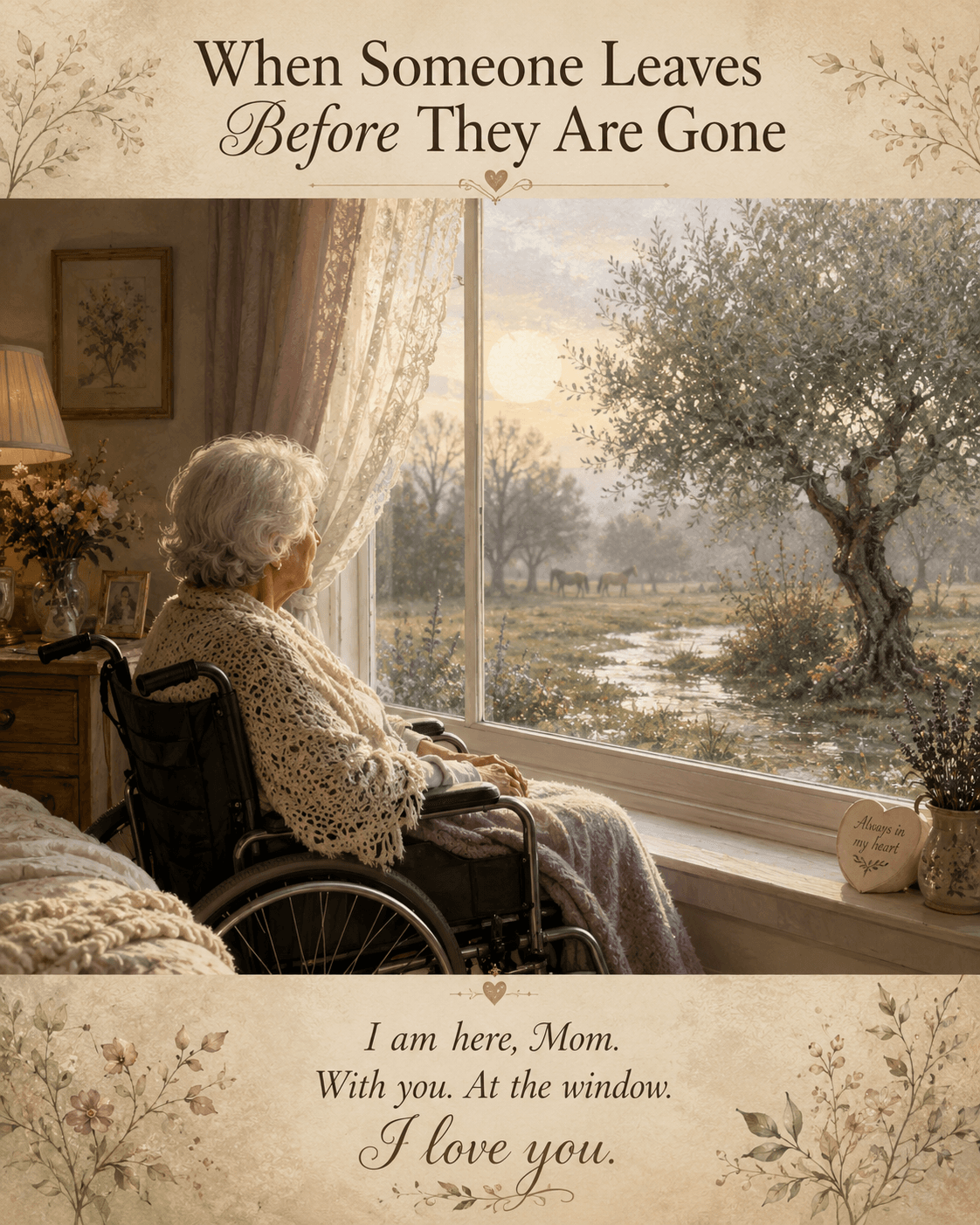
There is a guest room.
There is a window.
There are horses beneath the trees.
“The horses were standing there again,” she sometimes says.
Then she looks past us.
Not at the wall.
Not at the room.
At something farther away.
Something we cannot see.
My brother and I have tried to fit the pieces together.
Who was there?
Why that farm?
Was it a good place?
Was it a painful place?
Who saw her there?
Who missed seeing her there?
But her words come like dry leaves across a yard.
One here.
One there.
Just enough to know there had been a tree.
Not enough to draw the whole farm.
Some days she knows us.
Some days she searches for us among other names.
Sometimes she gives me children I do not have.
“How are the four?” she asks.
I smile.
“Good, Mom.”
I do not say: three.
Not today.
Today there are four.
If there are four in her world, I let them stay there.
Sometimes she looks at my brother and does not see my brother.
She sees my father.
Her voice changes. Her face grows softer and more confused all at once. She speaks to him as if the years have rolled backward. As if time made a mistake and let him back into the room.
My brother stands there.
His hands uncertain.
A son in a moment for which no one prepared him.
How does one answer someone who looks through you and loves someone else?
So he smiles.
Softly.
Awkwardly.
Sorrowfully.
In that little room, we learn that dementia does not only steal memory. It rearranges people. It pulls faces from old photographs and places them over the living.
My mother rubs her fingers along the edge of her sleeve.
She looks past his shoulder.
“She doesn’t like me,” she whispers.
“Who, Mom?”
But the answer is gone before it lands.
Only the feeling remains.
It sits between us on the floor.
I move closer.
“I am here,” I say.
She looks at me.
Not quite at me.
But almost.
For a moment, something returns.
A small light.
An expression.
My mother’s face inside my mother’s face.
“You are my child,” she says.
I hold my breath.
Then she drifts away again.
We bring flowers.
We fold blankets.
We straighten a cushion.
We answer questions that come from another year.
We let the horses stand beneath the trees.
We walk with her to the edge of a farm we never knew.
Before, I would have tried to correct things.
“No, Mom, that’s not true.”
“No, Mom, you are not there.”
“No, Mom, that was long ago.”
“No, Mom, three children, not four.”
Now those sentences lie heavy on my tongue.
I swallow them back.
Some truths do not help.
Some truths only make a person lonelier.
So I choose other sentences.
“Tell me about the horses.”
“Was it warm there?”
“Was the window open?”
“Were the trees tall?”
Sometimes she answers.
Sometimes she does not.
Sometimes she only looks at a place behind me.
And I sit there with my feet in today, while my mother lies somewhere at a window in Jakkalsdrif, watching horses graze beneath the trees.
Life changes roles without asking.
First there were children in my arms.
Children in car seats.
Children with fevers.
Children with schoolbags.
Children crying.
Children dreaming.
I buckled, fixed, encouraged, protected.
Then, one by one, they began walking forward.
Their own keys.
Their own roads.
Their own decisions.
Their own front doors.
I waved.
Proud.
Afraid.
Grateful.
With prayers I did not always say out loud.
And while my hands were still learning how to hold less tightly, my mother grew fragile.
Slower steps.
A thinner voice.
Pills on the table.
Appointments on the calendar.
Repetition.
Waiting rooms.
“We’ll see.”
A person thinks there will be a day when you feel ready.
There is not.
My mother taught me to speak.
Now I listen as her words disappear one by one.
She taught me names.
Now names fall from her hands like buttons from an old tin.
She woke me for school.
Now I want to keep her awake in this world.
Just a little longer.
But Jakkalsdrif is calling.
Or the past.
Or pain.
Or youth.
Or something that was never fully told.
I do not know.
I only know that when she is at that window, I should not draw the curtains.
I should sit beside her.
I should look where she is looking.
Even when I see nothing.
Perhaps love looks like this now:
A chair beside her bed.
A hand over hers.
A soft, “Yes, Mom.”
A blanket tucked beneath her chin.
A daughter who stops arguing with a world already moving halfway away from here.
Outside, the little birds chatter again in the wild olive tree.
The winter sun lies pale across the wet grass.
My coffee has gone cold.
I pick up my phone.
My mother’s name looks back at me.
For a moment, I want to call her.
Then I put the phone down again.
I look out the window.
At the olive tree.
At the pale winter sun.
At the place where no horses stand.
And still I whisper:
“I am here, Mom.
With you.
At the window.
With the horses.
I love you.”
Kommentaar
Wees die eerste om kommentaar te lewer.